Project Overview
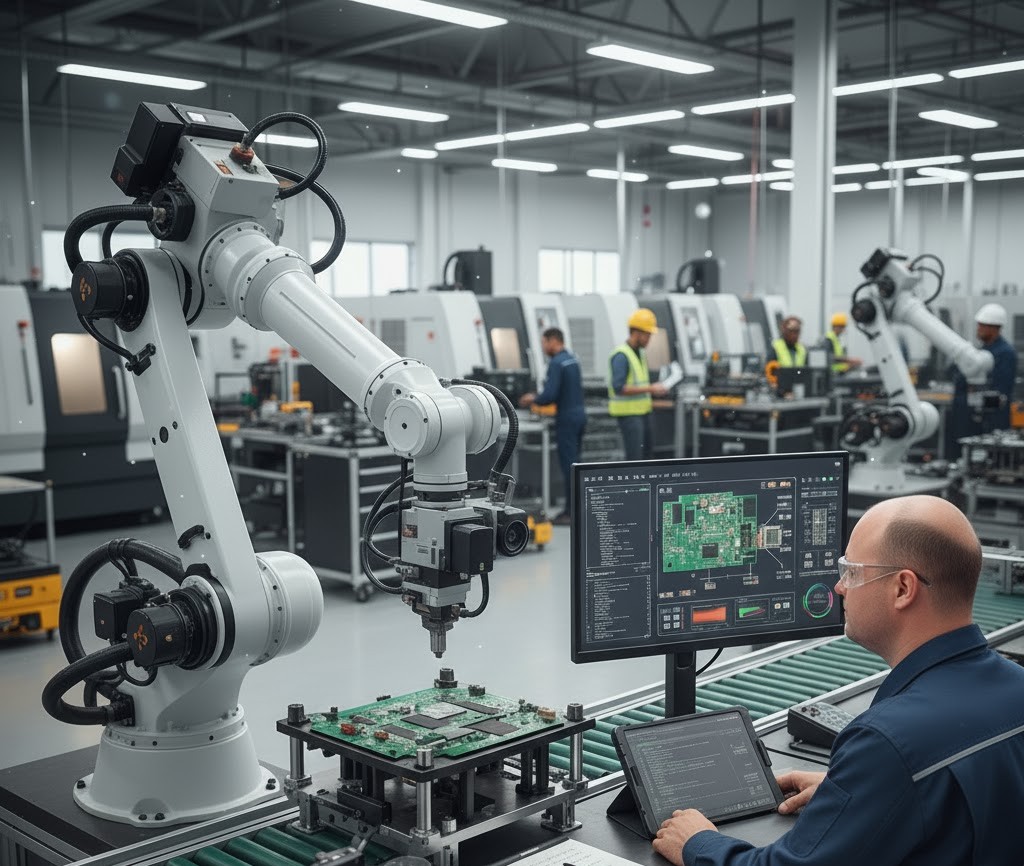
In this case study, we’ll walk through building a complete real-time defect detection system for a manufacturing line, from data collection to deployment.
Requirements
- Process 30 parts per minute
- Detect 5 different defect types
- < 1% false positive rate
- 99% uptime
System Architecture
1
2
[Camera] → [Image Capture] → [Preprocessing] → [AI Model]
    → [Post-processing] → [Decision Engine] → [Alert System]
Phase 1: Data Collection (Week 1-2)
Camera Setup
- Resolution: 2048x2048 pixels
- Frame rate: 60 FPS
- Lighting: LED ring light, 5500K
- Position: 30cm above conveyor
Data Gathering Strategy
1
2
3
4
5
6
7
8
9
10
11
12
13
14
15
16
17
import cv2
from datetime import datetime

def capture_training_data():
    cap = cv2.VideoCapture(0)
    frame_count = 0

    while frame_count < 5000:
        ret, frame = cap.read()
        if ret:
            timestamp = datetime.now().strftime("%Y%m%d_%H%M%S")
            filename = f"data/raw_{timestamp}_{frame_count}.jpg"
            cv2.imwrite(filename, frame)
            frame_count += 1

            if frame_count % 100 == 0:
                print(f"Captured {frame_count} images")
Phase 2: Data Annotation (Week 2-3)
Labeling Process
- Use CVAT for batch annotation
- Define clear defect categories
- Multiple annotators for quality
- Regular calibration meetings
Quality Checks
- Inter-annotator agreement > 95%
- Regular spot checks
- Clear edge case guidelines
Phase 3: Model Development (Week 3-5)
Model Selection
After testing multiple architectures:
- YOLOv8m: Best balance of speed/accuracy
- Input size: 640x640
- Augmentation: Heavy for robustness
Training Configuration
1
2
3
4
5
6
7
8
9
10
11
12
13
14
15
16
17
from ultralytics import YOLO

model = YOLO('yolov8m.pt')

results = model.train(
    data='defects.yaml',
    epochs=150,
    imgsz=640,
    batch=32,
    patience=20,
    optimizer='AdamW',
    lr0=0.001,
    weight_decay=0.0005,
    augment=True,
    mosaic=1.0,
    mixup=0.1
)
Results
- Precision: 97.8%
- Recall: 96.5%
- mAP@50: 98.2%
- Inference time: 22ms
Phase 4: Optimization (Week 5-6)
TensorRT Conversion
1
2
3
4
5
6
7
8
# Export to TensorRT for 3x speedup
model.export(format='engine', device=0, half=True)

# Load optimized model
model_trt = YOLO('best.engine')

# Inference time improved
# Before: 22ms → After: 7ms
Post-Processing Pipeline
1
2
3
4
5
6
7
8
9
10
11
12
def parse_results(results):
    """Extract detection information from model results"""
    detections = []
    # Results is a list, handle the first image
    for result in results:
        for box in result.boxes:
            detections.append({
                'class': int(box.cls),
                'conf': float(box.conf),
                'bbox': box.xyxy.tolist()[0]
            })
    return detections
Phase 5: Deployment (Week 6-7)
Hardware Setup
- GPU: NVIDIA Jetson AGX Xavier
- RAM: 32GB
- Storage: 512GB NVMe SSD
- I/O: GPIO for PLC integration
Production Pipeline
1
2
3
4
5
6
7
8
9
10
11
12
13
14
15
16
17
18
19
20
21
22
23
24
25
26
27
28
29
30
31
32
33
34
35
36
37
38
39
40
41
42
43
44
45
46
47
48
49
from queue import Queue
from ultralytics import YOLO

class DefectDetector:
    def __init__(self, model_path):
        self.model = YOLO(model_path)
        self.queue = Queue(maxsize=10)

    def process_frame(self, frame, conf_threshold=0.7, iou_threshold=0.45):
        # Preprocess
        img = self.preprocess(frame)

        # Detect with built-in NMS (more efficient than manual)
        results = self.model(
            img,
            conf=conf_threshold,  # Confidence threshold
            iou=iou_threshold,    # IoU threshold for NMS
            verbose=False
        )

        # Extract detections from results
        defects = self.parse_results(results)

        # Log results
        self.log_detection(defects)

        return defects

    def parse_results(self, results):
        """Extract detection information from YOLO results"""
        detections = []
        # Results is a list, handle the first image
        for result in results:
            for box in result.boxes:
                detections.append({
                    'class': int(box.cls),
                    'conf': float(box.conf),
                    'bbox': box.xyxy.tolist()[0]
                })
        return detections

    def run(self):
        # Main processing loop
        while True:
            frame = self.queue.get()
            defects = self.process_frame(frame)

            if defects:
                self.trigger_alert(defects)
Phase 6: Monitoring (Ongoing)
Key Metrics Dashboard
- Throughput (parts/minute)
- Detection rate
- False positive/negative rates
- System uptime
- Processing latency
Continuous Improvement
1
2
3
4
5
6
# Collect edge cases
def log_uncertain_cases(results):
    for r in results:
        if 0.5 < r.conf < 0.75:
            # Save for review and retraining
            save_for_review(r)
Results & Impact
Performance
- Processing speed: 45 parts/minute (150% of requirement)
- Detection accuracy: 98.5%
- False positive rate: 0.7%
- Uptime: 99.6%
Business Impact
- 40% reduction in defective products shipped
- 60% faster quality control
- $500K annual savings
- ROI achieved in 4 months
Lessons Learned
- Start simple: Begin with classical CV, add AI where needed
- Production data is gold: Lab data ≠ production data
- Monitoring is crucial: What gets measured gets improved
- Budget for iteration: First model is never the final model
Conclusion
Building a production defect detection system requires careful planning, rigorous testing, and continuous iteration. But the impact on quality and efficiency makes it well worth the effort.
Want to discuss your defect detection project? Get in touch!
Related Resources
More Case Studies
- DIY 3D Print Failure Detector - Budget build with Raspberry Pi
- 3D Print Monitor ROI Analysis - Real-world savings breakdown
Tutorials
- Getting Started with YOLO - YOLO fundamentals
- YOLOv8 PCB Defect Detection - Detailed PCB example
- 5 Common Mistakes - Pitfalls to avoid
Hardware & Platforms
- Jetson Nano Setup Guide - Edge deployment
- Best Budget Cameras - Hardware selection
- Keyence vs Cognex - Commercial options
Planning
- ROI Calculator - Build your business case
Code Repository
Full source code available at: github.com/detectdefects/realtime-defect-detection